A
Alex Baker
Data Engineer Intern
“As a recent graduate, aicareerspace.com's AI matching surfaced internships I would have missed. I started getting interviews within a few weeks and accepted an offer shortly after.”
Match Smarter, Not Harder
aicareerspac·e connecting AI talent with the right opportunities.
Real results with AI job matching—faster offers for candidates, higher quality pipelines for hiring teams.
Alex Baker
Data Engineer Intern
“As a recent graduate, aicareerspace.com's AI matching surfaced internships I would have missed. I started getting interviews within a few weeks and accepted an offer shortly after.”
Elena Markov
Senior Data Scientist
“The AI Job Match fit my profile perfectly—relevant roles only, no noise. I moved straight to final rounds for two top positions.”
David Chen
AI Engineer
“Resume Fit Analyzer was a game‑changer. I tailored my resume to each post and saw a huge uptick in callbacks.”
Priya Narayanan
Machine Learning Intern
“Saved jobs + tracker kept my search organized. aicareerspace.com matched me to an ML internship that aligned with my skills and goals.”
S. Patel
Senior Technical Recruiter
“After posting on aicareerspace.com we received fewer but far stronger applications. Candidate quality and skill alignment were excellent.”
J. Rivera
Head of Engineering
“The first week brought short‑listed, interview‑ready ML engineers. Best signal‑to‑noise we’ve seen from any job board.”
This tutorial introduces a fundamental architectural shift from brittle, linear AI chains to resilient, cyclical agents using LangGraph.js and Gemini 2.5 Flash. It demonstrates a 'Drafter-Critic' loop where an agent generates content, critiques its own work, and iteratively refines it based on feedback, mimicking human review processes. For AI professionals and startup founders, this pattern is key to building robust, self-correcting applications that don't simply fail when an LLM hallucinates. Mastering this stateful, graph-based orchestration is becoming essential for creating production-grade, autonomous AI systems.
This article cautions beginner developers against starting with PostgreSQL and SQLite, highlighting that PostgreSQL's production hosting and management complexities add unnecessary stress, while SQLite falters under real-world traffic despite being great for local learning. It underscores that good development involves evaluating cost, scale, and trade-offs to make sustainable technical decisions—a critical skill for AI professionals building scalable systems and startups optimizing resources. By avoiding these common pitfalls, teams can focus on delivering robust, client-focused solutions without getting bogged down by premature complexity.
This article shifts focus from technical tutorials to the mental models needed when software scales, arguing that at scale, the hardest problems are decision systems, not technical primitives. It emphasizes constraining before optimizing, using architecture as 'decision hygiene' to manage complexity, and building systems that are auditable and fail loudly—crucial for startups aiming to scale reliably. For AI professionals and job seekers, it offers a framework for designing robust systems that survive real-world use, highlighting that tools matter less than strong constraints and clear boundaries.
This article poses a critical forward-looking question for the AI field: can we build systems that not only detect bias but dynamically adapt to evolving social norms and fragmented truths? It challenges experts to move beyond static models and consider how AI can contextualize culture and evolve alongside society to maintain fairness. For AI professionals and startups, this underscores a pressing need to develop more agile, ethically-aware architectures that bridge the gap between rigid algorithms and fluid human understanding. Success in this area could define the next generation of trustworthy, socially-responsible AI applications.
This contrarian perspective warns that the unchecked proliferation of autonomous systems poses significant societal risks, challenging the prevailing narrative of pure innovation. The author highlights critical dangers including the erosion of human agency and moral judgment, potential for mass unemployment exacerbating inequality, and the inherent limitations of 'explainable AI' in opaque black-box systems. For AI professionals and startup founders, this serves as a crucial reminder to prioritize ethical frameworks and comprehensive safeguards alongside technical development. The piece underscores that ensuring equitable distribution of AI's benefits requires a cautious, accountable approach to deployment, not just a focus on efficiency gains.
Google's Gemini AI is introducing a powerful new capability to analyze personal data like photos and emails for more contextual and helpful responses. Initially launching exclusively for paying subscribers, this opt-in feature represents a significant step towards deeply personalized AI assistants. For AI professionals and startups, this highlights the growing market for privacy-conscious, value-added AI services that justify premium pricing. Job seekers should note the rising demand for expertise in multimodal AI, data privacy, and developing user-trust frameworks for sensitive features.
This video presents a novel visualization experiment designed to make the dynamics of AI model training—such as drift, stabilization, and loss of stability—directly visible. It explores whether this visual approach can complement traditional metrics and evaluations by providing intuitive insights into complex failure modes during training. For AI professionals and researchers, this tool could offer a faster, more intuitive way to diagnose and debug training instability, potentially speeding up model development cycles. Startup founders and engineers should take note, as improving training reliability is crucial for deploying robust AI systems and reducing computational waste.
Civilization VII is launching on iPhone and iPad as an 'Arcade Edition' exclusive to Apple's subscription service, marking a major shift for premium strategy games onto mobile platforms. Developed by Behaviour Interactive with oversight from Firaxis, this move signals growing opportunities for AI professionals in mobile game optimization and adaptive UI design, as developers tackle porting complex PC titles. For startups, it highlights the viability of subscription-based models over traditional purchases, evidenced by Netflix's gaming success. However, the version will lack DLC and multiplayer, underscoring the technical and business trade-offs in cross-platform expansions.
Algonomy, a pioneer in AI-native retail solutions, has partnered with Databricks as a Built On partner to launch RetailAI, an agentic intelligence platform built natively on the Databricks Data Intelligence Platform. This collaboration transforms traditional retail planning workflows—like forecasting, pricing, and logistics—into conversational AI experiences, combining Algonomy's deep retail algorithms with Databricks' scalable data governance and AI tools. For AI professionals and startups, it demonstrates how specialized domain expertise can integrate with enterprise platforms to accelerate time-to-value and reduce ROI risks in complex industries. The partnership highlights a growing trend where agentic AI delivers immediate, measurable business impact, offering job seekers opportunities in retail AI, data engineering, and AI governance roles.
The AI industry is maturing beyond simple chatbots by adopting formal design patterns that enable reliable, safe, and autonomous agentic systems. Key blueprints include Plan-Then-Execute for accuracy in multi-step workflows, Reflective patterns for self-correction and safety, and Human-in-the-Loop gateways for trust in high-stakes domains. For AI professionals and startups, mastering these patterns—like Multi-Agent Orchestration and Context-Aware Memory—is crucial for building the next generation of enterprise-grade AI assistants that solve complex problems rather than just generating text.
A novel evolutionary learning system called GENREG achieved 72.16% accuracy on a vision-language grounding task with 100% neuron saturation—a state that would cripple gradient-based networks. This research reveals that binary, saturated activations may be optimal for neural networks, but gradient descent is fundamentally blind to these solutions due to its reliance on smooth gradients. For AI professionals and startups, this challenges core assumptions about network training and opens avenues for more efficient, hardware-friendly models that bypass traditional backpropagation constraints.
The Reddit community is discussing the emerging concept of Compression-Aware Intelligence (CAI), which likely explores how AI models can be designed or optimized with data compression principles in mind. This approach could lead to more efficient neural networks that require less computational power and memory, addressing key scalability challenges. For AI professionals and startups, CAI represents a frontier in model efficiency, potentially reducing training and inference costs significantly. Job seekers should note that expertise in model optimization and information theory may become increasingly valuable as this field develops.
Join thousands accelerating their careers with AI tools and curated jobs.
Get answers to common questions about aicareerspac·e's AI-powered career and hiring platform
aicareerspac·e uses AI-powered semantic search to match your skills, experience, and interests to AI/ML roles like Machine Learning Engineer, Data Scientist, MLOps Engineer, and AI Researcher. Our algorithms analyze your resume and profile to surface the best-fit openings, not just keyword matches.
Yes. Our built-in Application Tracker lets you add positions, store notes, track statuses (Applied, Interview, Offer), and keep everything organized across multiple companies—so you never lose progress.
Absolutely. The AI Resume Fit Analyzer compares your resume to any listing and highlights missing skills, keywords, and experience gaps—helping you tailor your resume for higher interview rates.
You can bookmark jobs, build shortlists, and return to saved roles anytime. Your favorites sync with the tracker so you can move from discovery to application in one click.
Based on your profile, skills, and activity, aicareerspac·e delivers AI-curated job recommendations, including remote AI jobs, senior machine learning roles, data science positions, and more—updated continuously.
Yes. New users get free trial access to explore AI matching, job search tools, and starter features. Upgrade anytime for advanced capabilities like deeper resume analysis and premium insights.
Companies can publish roles on aicareerspac·e to reach thousands of AI professionals. Our platform promotes listings to relevant talent pools across Machine Learning, Data Engineering, NLP, Computer Vision, and Product AI.
Yes. Set targeted alerts (e.g., Remote Machine Learning Engineer, Senior Data Scientist, MLOps) and receive updates when new matching roles are posted.
Yes. Verified students receive a 50% discount on paid plans—just provide a valid student ID during verification to unlock the offer.
Free tools, curated jobs, and alerts delivered to you.
Stay ahead with expert tips on AI careers, remote work strategies, and professional growth
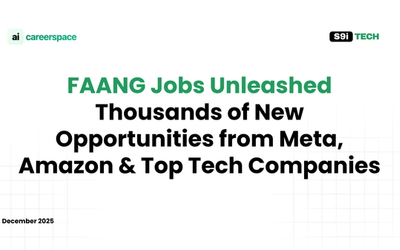
Find AI & tech jobs at FAANG companies. Thousands of opportunities in ML, data science & software engineering at Meta, Amazon, Google & top tech firms.

Stop over-engineering your MVP. Most startups waste months on Kubernetes when Docker Swarm gets you to production in days. Learn why boring infrastructure beats resume-driven development—and how to migrate later when you actually need the complexity.
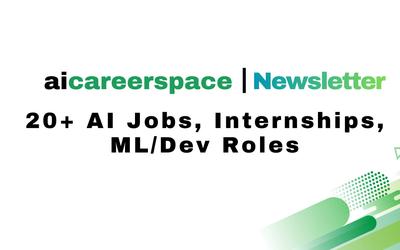
Find 20+ top AI Jobs & Internships for ML Scientists, Software Engineers, and Managers in our latest newsletter! Plus, top AI news & insights. Apply now!
Join thousands accelerating their careers with AI tools and curated jobs.