A
Alex Baker
Data Engineer Intern
“As a recent graduate, aicareerspace.com's AI matching surfaced internships I would have missed. I started getting interviews within a few weeks and accepted an offer shortly after.”
Match Smarter, Not Harder
aicareerspac·e connecting AI talent with the right opportunities.
No jobs found matching your criteria.
Try adjusting your filters or search terms.
Real results with AI job matching—faster offers for candidates, higher quality pipelines for hiring teams.
Alex Baker
Data Engineer Intern
“As a recent graduate, aicareerspace.com's AI matching surfaced internships I would have missed. I started getting interviews within a few weeks and accepted an offer shortly after.”
Elena Markov
Senior Data Scientist
“The AI Job Match fit my profile perfectly—relevant roles only, no noise. I moved straight to final rounds for two top positions.”
David Chen
AI Engineer
“Resume Fit Analyzer was a game‑changer. I tailored my resume to each post and saw a huge uptick in callbacks.”
Priya Narayanan
Machine Learning Intern
“Saved jobs + tracker kept my search organized. aicareerspace.com matched me to an ML internship that aligned with my skills and goals.”
S. Patel
Senior Technical Recruiter
“After posting on aicareerspace.com we received fewer but far stronger applications. Candidate quality and skill alignment were excellent.”
J. Rivera
Head of Engineering
“The first week brought short‑listed, interview‑ready ML engineers. Best signal‑to‑noise we’ve seen from any job board.”
A developer has launched Bast, an open-source CLI tool that addresses a critical security gap in AI-powered coding workflows. Unlike standard AI terminals that send unfiltered prompts—including sensitive data like credentials and environment variables—to LLMs, Bast routes requests through a security gateway to automatically redact PII, block injections, and provide full audit logs. This makes it a vital tool for professionals and startups working with production systems or regulated data, ensuring compliance without sacrificing productivity. Built in Go and MIT-licensed, Bast also functions as a full-featured AI assistant with command explanation, error recovery, and agentic capabilities.
The AI industry's competitive tensions have spilled into the public arena, with OpenAI CEO Sam Altman launching a sharp critique against rival Anthropic over its new Super Bowl advertisements. In a lengthy post on X, Altman labeled Anthropic's marketing approach as 'dishonest' and 'authoritarian,' highlighting the high-stakes battle for public trust and market share. For AI professionals and startups, this public feud underscores the intense pressure to differentiate and ethically communicate capabilities in a crowded market. Job seekers should note that such high-profile clashes can signal shifting company cultures and strategic priorities within leading AI firms.
A hiring manager reveals that most junior developer candidates fail interviews not due to technical skills, but because they cannot clearly articulate their project decisions and thought processes. The key differentiator is the ability to explain why specific technologies were chosen, what challenges were faced, and what would be done differently, rather than just listing buzzwords. This highlights a critical, often overlooked skill for AI professionals and job seekers: effective communication about technical work is as valuable as coding ability. For startup founders, this underscores the importance of assessing problem-solving and communication skills early in the hiring process to build teams that can collaborate and explain their reasoning.
This article provides a critical technical blueprint for securing Personally Identifiable Information (PII) within Node.js microservices during testing phases. For AI professionals and startup founders building data-intensive applications, it outlines a three-pillar strategy—data masking, environment-aware logging, and strict access control—to prevent costly compliance breaches and protect user trust. The included practical code snippets for Express middleware and Winston logging offer immediately actionable solutions for engineering teams. Implementing these practices is essential for any organization handling sensitive data, as it directly mitigates legal risks and operational vulnerabilities in modern, distributed architectures.
A developer has achieved a remarkable feat of software archaeology by getting modern C++23 code to run natively on Windows 95. This was done by using the MSVC 2026 compiler to generate stripped-down 32-bit code and linking it with a Visual C++ 6.0 linker, alongside building a custom, minimal Standard Library implementation. The project proves that modern language features like modules, smart pointers, and std::expected can be leveraged efficiently, even on 30-year-old hardware, challenging the narrative of planned obsolescence. For AI professionals and startups, this serves as a powerful lesson in resource efficiency, backward compatibility, and the potential to build high-level, cross-platform software without unnecessary bloat.
This comprehensive beginner's guide to Java covers everything from installation and basic syntax to variables, conditionals, loops, and arrays, providing a solid foundation in one of the world's most popular programming languages. For AI professionals and startups, Java remains crucial for building scalable backend systems, Android apps, and enterprise-level AI applications that require robustness and performance. Job seekers should note that Java skills are consistently in high demand across industries, making this tutorial a valuable starting point for career development in software engineering. Mastering these fundamentals enables developers to contribute to everything from web services to complex data processing pipelines.
This article traces the evolution from UNIX's origins at Bell Labs in the 1960s to Linus Torvalds creating the Linux kernel from scratch in 1991, inspired by UNIX and MINIX. It clarifies that Linux is a kernel, which combined with GNU software forms a complete, free, and open-source operating system known for its security, lightweight nature, and multi-user support. For AI professionals and startups, understanding Linux is foundational, as it powers the vast majority of cloud servers, development environments, and AI/ML infrastructure, offering stability, customization, and cost efficiency. The prevalence of distributions like Ubuntu, RHEL, and Debian makes Linux proficiency a critical skill for developers, DevOps engineers, and anyone building scalable tech solutions.
Senator Ed Markey is demanding that Immigration and Customs Enforcement (ICE) confirm or deny the existence of a database tracking peaceful protesters, citing a memo instructing agents to 'capture it all' including images and license plates. This raises serious concerns about First Amendment violations and the use of surveillance technologies like facial recognition, which Markey plans to legislate against. For AI professionals and startups, this highlights the ethical risks and regulatory scrutiny surrounding data collection tools, emphasizing the need for transparent and lawful AI deployments. Job seekers in tech should be aware of growing public and political backlash against invasive monitoring systems that could impact career opportunities in government-contracted AI projects.
Adobe reversed its plan to discontinue the 30-year-old 2D animation software Animate after significant backlash from animators and users, who criticized the move as disrespectful amid the company's growing focus on AI tools. The initial announcement, which would have cut off access to decades of creative work, sparked anxiety and led many to seek alternatives, highlighting the fragile trust between software giants and their professional communities. For AI professionals and startups, this episode underscores the challenges in balancing innovation with legacy support, and the critical role of user advocacy in shaping product roadmaps. It also serves as a cautionary tale about how abrupt shifts toward AI-driven paradigms can alienate core user bases and damage brand loyalty.
Texas Instruments' acquisition of Silicon Labs signals a strategic push to dominate the IoT market, fueled by the growing viability of edge AI solutions. This move highlights how semiconductor giants are consolidating to capture value in smart devices and industrial automation. For AI professionals and startups, it underscores the critical intersection of hardware and AI at the edge, creating opportunities in chip design, embedded systems, and energy-efficient computing. Job seekers should watch for roles in IoT and edge AI development as this acquisition reshapes the competitive landscape.
The AI Expo 2026 highlighted the industry's pivot from passive automation to 'agentic' AI systems that reason, plan, and execute tasks like true digital co-workers. For enterprises to deploy these autonomous agents successfully, experts emphasized that robust data governance, high-quality connected data, and secure, scalable infrastructure are non-negotiable foundations. This evolution signals a major shift for AI professionals and startups, creating demand for skills in retrieval-augmented generation (RAG), AI observability, and human-centred change management. Ultimately, the path to the agentic enterprise requires parallel progress in technology, trust, and organizational culture to close the automation gap.
Citi is leveraging its Austin hub to fundamentally rebuild its banking core with AI at scale, creating a blueprint for the future of finance. This shift involves moving from experimentation to enterprise execution, including agentic AI systems, Google Cloud's Vertex AI for employee tools, and a leaner operating model aimed at saving billions annually. For AI professionals and startups, this case study highlights the growing demand for applied AI in fintech, opportunities in AI infrastructure and regulatory tech, and the importance of hybrid-cloud architectures. Job seekers should note Citi's focus on AI-native workflows and roles in crypto custody or quantum computing, while founders can learn from its partnership-driven approach to digital transformation.
Join thousands accelerating their careers with AI tools and curated jobs.
Get answers to common questions about aicareerspac·e's AI-powered career and hiring platform
aicareerspac·e uses AI-powered semantic search to match your skills, experience, and interests to AI/ML roles like Machine Learning Engineer, Data Scientist, MLOps Engineer, and AI Researcher. Our algorithms analyze your resume and profile to surface the best-fit openings, not just keyword matches.
Yes. Our built-in Application Tracker lets you add positions, store notes, track statuses (Applied, Interview, Offer), and keep everything organized across multiple companies—so you never lose progress.
Absolutely. The AI Resume Fit Analyzer compares your resume to any listing and highlights missing skills, keywords, and experience gaps—helping you tailor your resume for higher interview rates.
You can bookmark jobs, build shortlists, and return to saved roles anytime. Your favorites sync with the tracker so you can move from discovery to application in one click.
Based on your profile, skills, and activity, aicareerspac·e delivers AI-curated job recommendations, including remote AI jobs, senior machine learning roles, data science positions, and more—updated continuously.
Yes. New users get free trial access to explore AI matching, job search tools, and starter features. Upgrade anytime for advanced capabilities like deeper resume analysis and premium insights.
Companies can publish roles on aicareerspac·e to reach thousands of AI professionals. Our platform promotes listings to relevant talent pools across Machine Learning, Data Engineering, NLP, Computer Vision, and Product AI.
Yes. Set targeted alerts (e.g., Remote Machine Learning Engineer, Senior Data Scientist, MLOps) and receive updates when new matching roles are posted.
Yes. Verified students receive a 50% discount on paid plans—just provide a valid student ID during verification to unlock the offer.
Free tools, curated jobs, and alerts delivered to you.
Stay ahead with expert tips on AI careers, remote work strategies, and professional growth
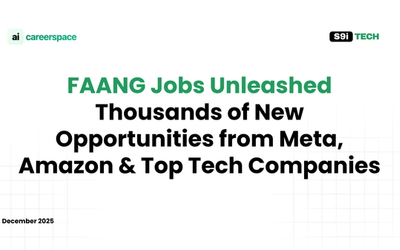
Find AI & tech jobs at FAANG companies. Thousands of opportunities in ML, data science & software engineering at Meta, Amazon, Google & top tech firms.

Stop over-engineering your MVP. Most startups waste months on Kubernetes when Docker Swarm gets you to production in days. Learn why boring infrastructure beats resume-driven development—and how to migrate later when you actually need the complexity.
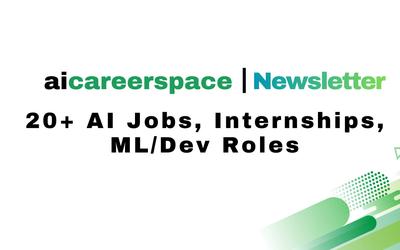
Find 20+ top AI Jobs & Internships for ML Scientists, Software Engineers, and Managers in our latest newsletter! Plus, top AI news & insights. Apply now!
Join thousands accelerating their careers with AI tools and curated jobs.